
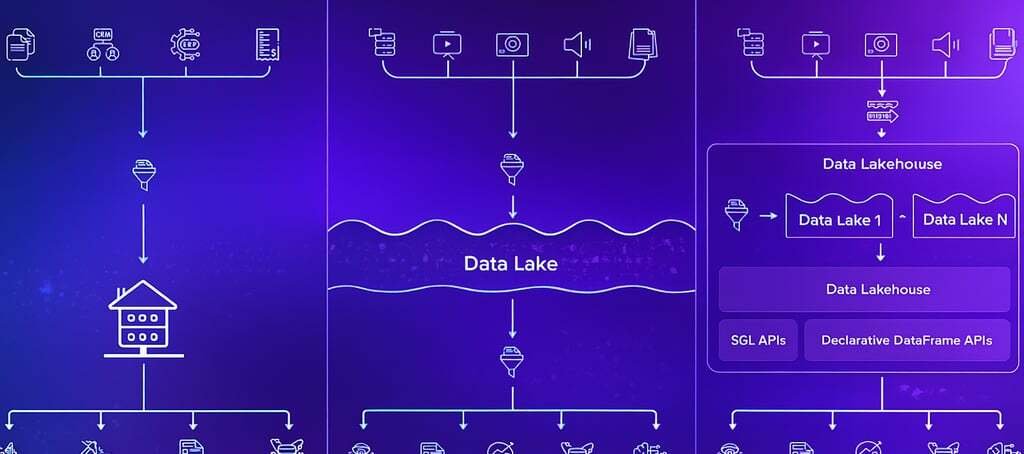
This blog explains Lakehouse vs Data Warehouse vs Data Lake in a clear and practical way, using Databricks as the reference platform.
As data volumes grow and use cases expand into real-time analytics and AI, many organisations struggle to choose the right data architecture. Terms like data lake, data warehouse, and lakehouse are often used together, which creates confusion. Each approach solves different problems, and choosing the wrong one can lead to slow systems, high costs, and failed analytics projects.
This blog explains Lakehouse vs Data Warehouse vs Data Lake in a clear and practical way, using Databricks as the reference platform. By the end, you will understand how each architecture works, where it fits best, and why many companies are moving toward the lakehouse model.
Why Data Architecture Matters More Than Ever
Modern businesses depend on data for:
Operational decisions
Customer insights
Forecasting and planning
Machine learning and AI
Real-time monitoring
If data is hard to access, slow to process, or unreliable, teams lose trust and productivity. Architecture decisions made early often determine whether a data platform can scale or becomes a bottleneck.
Understanding the difference between a data lake, data warehouse, and lakehouse helps teams build systems that support both today’s needs and future growth.
What Is a Data Lake
Definition of a Data Lake
A data lake is a storage system that holds large amounts of raw data in its original format. This includes structured, semi-structured, and unstructured data.
Common data lake storage includes:
Cloud object storage
Files such as CSV, JSON, Parquet
Logs, images, and sensor data
How Data Lakes Work
Data is ingested into the lake with minimal transformation. Processing happens later when data is read for analysis.
This approach supports flexibility and low storage cost.
Strengths of Data Lakes
Can store any type of data
Low storage cost
Scales easily
Good for data science experiments
Limitations of Data Lakes
No built-in data quality checks
Risk of inconsistent schemas
Hard to manage governance
Slower analytics performance
Data can become messy over time
Without strong controls, data lakes often turn into data swamps.
What Is a Data Warehouse
Definition of a Data Warehouse
A data warehouse is a structured system designed for analytics and reporting. Data is cleaned, transformed, and organised before it is stored.
Common warehouses include Snowflake, Redshift, and BigQuery.
How Data Warehouses Work
Data is processed using ETL pipelines before loading. Tables are optimised for SQL queries and dashboards.
Warehouses focus on business reporting and metrics.
Strengths of Data Warehouses
Fast query performance
Strong schema enforcement
Reliable business reporting
Good governance and access control
Limitations of Data Warehouses
Higher storage and compute costs
Limited support for unstructured data
Less flexible for machine learning
Data duplication across systems
Warehouses work well for reporting but struggle with modern AI and data science workloads.
What Is a Lakehouse
Definition of a Lakehouse
A lakehouse combines the flexibility of a data lake with the performance and reliability of a data warehouse. It stores data in low-cost object storage while adding features like transactions, schema enforcement, and fast analytics.
Databricks is one of the leading platforms for the lakehouse architecture.
How the Lakehouse Works in Databricks
In Databricks, the lakehouse uses:
Cloud storage for data
Delta Lake for reliability
Apache Spark for processing
SQL, Python, and ML tools in one platform
Data is stored once and used for many workloads.
Key Features of the Lakehouse
ACID transactions on data lake storage
Schema enforcement and evolution
Time travel and versioning
Unified analytics and machine learning
Lower cost compared to warehouses
Lakehouse vs Data Warehouse vs Data Lake: Core Differences
Storage
Data Lake stores raw files with no structure
Data Warehouse stores processed data in tables
Lakehouse stores structured and raw data together using open formats
Performance
Data Lake performance depends on processing tools
Data Warehouse is optimised for SQL analytics
Lakehouse delivers fast analytics using optimised engines like Databricks SQL
Data Types Supported
Data Lake supports all data types
Data Warehouse mainly supports structured data
Lakehouse supports structured, semi-structured, and unstructured data
Cost
Data Lake has the lowest storage cost
Data Warehouse has higher storage and compute costs
Lakehouse balances low storage cost with flexible compute
Governance
Data Lake has weak governance by default
Data Warehouse has strong governance
Lakehouse provides strong governance using tools like Unity Catalog
Machine Learning Support
Data Lake supports experiments but lacks reliability
Data Warehouse is not ideal for ML workflows
Lakehouse supports full ML lifecycle on the same data
Why Databricks Is Built for the Lakehouse
Databricks was designed to solve the problems of both data lakes and data warehouses.
Delta Lake
Delta Lake adds reliability to data lakes by providing:
Transactions
Schema checks
Data versioning
Efficient reads and writes
This removes the risk of messy data.
Unified Analytics and AI
Databricks supports:
Data engineering
Business analytics
Machine learning
Streaming workloads
All using the same data and platform.
Medallion Architecture
Databricks encourages the Medallion pattern:
Bronze for raw data
Silver for clean data
Gold for business-ready data
This structure keeps data organised and trusted.
When to Use Each Architecture
When a Data Lake Is Enough
Storing large volumes of raw data
Low-cost archival storage
Simple data science experiments
When a Data Warehouse Is the Right Choice
Heavy BI reporting
Stable schemas
Limited unstructured data
SQL-first analytics
When a Lakehouse Is the Best Option
Combining analytics and machine learning
Handling large and diverse data types
Reducing data duplication
Supporting real-time and batch workloads
Scaling data and AI together
For many modern companies, the lakehouse provides the most flexibility.
Common Mistakes When Choosing Architecture
Many teams make mistakes such as:
Building a data lake without governance
Using a warehouse for machine learning
Duplicating data across systems
Ignoring future AI needs
Over-engineering too early
Architecture should support long-term goals, not just current reporting needs.
How to Migrate Toward a Lakehouse
A gradual approach works best.
Steps include:
Keep existing warehouse for reporting
Introduce a lakehouse for new use cases
Ingest raw data into the lakehouse
Apply Medallion architecture
Move advanced analytics and ML workloads
Optimise BI queries on the lakehouse
Databricks supports this hybrid approach well.
Lakehouse vs Data Warehouse vs Data Lake: Final Thoughts
The debate around Lakehouse vs Data Warehouse vs Data Lake is not about which one is better in all cases. It is about choosing the right architecture for modern data needs.
Data lakes offer flexibility but lack control.
Data warehouses offer performance but lack flexibility.
Lakehouses combine the strengths of both.
With platforms like Databricks, organisations no longer need separate systems for storage, analytics, and AI.
Conclusion: How Tenplus Helps You Choose and Build the Right Architecture
Choosing the right architecture is not just a technical decision. It affects cost, speed, scalability, and future AI adoption.
Tenplus helps organisations:
Assess current data platforms
Compare lakehouse, warehouse, and lake architectures
Design Databricks-based lakehouse solutions
Implement Medallion architecture
Build reliable pipelines and governance
Optimise cost and performance
Deliver working Proof of Concepts in 15 days
If your team wants clarity and confidence in choosing the right data architecture, Tenplus provides the expertise and speed to move forward without risk.
Book a free PoC with Tenplus today!
FAQs
What is the main difference between a data lake, data warehouse, and lakehouse?
A data lake stores raw data with little structure. A data warehouse stores clean, structured data for reporting. A lakehouse combines both by offering low-cost storage with strong performance and data reliability.
Why do companies choose a lakehouse over a data warehouse?
Companies choose a lakehouse because it supports analytics, real-time data, and machine learning on the same platform. It reduces data duplication and works better for modern AI use cases.
Is Databricks a data lake, data warehouse, or lakehouse?
Databricks is a lakehouse platform. It uses cloud storage with Delta Lake to provide data reliability, fast analytics, and support for machine learning in one system.




4 Responses